A landing page conversion happens when a visitor completes the specific action your page was designed to drive, whether that’s signing up, starting a trial, or making a purchase. Conversion rates vary by industry and intent, but strong performance usually comes from clarity rather than clever design. High-converting landing pages focus on one goal, maintain message consistency, guide attention through clear structure, and build trust at the moments visitors hesitate. Improving conversions is less about adding elements and more about removing confusion.
A landing page conversion happens when a visitor completes the one specific action your page was built to drive.
That action might be filling out a form, booking a demo, starting a free trial, or completing a purchase. Whatever the goal, a conversion is the moment a click turns into measurable progress for your business.
But most guides only cover half the story. They either define the term or list design tips without explaining why those tactics work.
If you’re running ads, sending email traffic, or building product funnels, this is the framework that turns visits into results.
Key takeaways
A conversion is the single action your landing page is built to drive.
Focused pages convert better than pages with multiple goals.
Message match between ad and page builds immediate clarity.
Clear structure matters more than clever design.
Short forms outperform long ones that ask too much upfront.
Conversion optimization is continuous testing, not a one-time fix.
What counts as a conversion?
A conversion happens when a visitor completes the specific action your landing page was designed to encourage.
Depending on your campaign goals, that action can take different forms. Here are a few examples you’re likely familiar with:
Conversion type
Examples
Lead generation conversions
Submitting a form for an e-bookRegistering for a webinarJoining a newsletter
Click-through conversions
Clicking a button to move into checkoutStarting a free trialDownloading an app
Sales conversions
Completing a direct purchaseUpgrading to a paid plan
Micro-conversions
Watching a demo videoClicking a pricing tabScrolling to a key section
Micro-conversions matter because they signal intent. But, your primary conversion is the one action that drives revenue or qualified leads.
Before optimizing a page, you need to define that action clearly. If the goal is vague, your conversion rate will reflect that confusion. Once you have your actions in mind, it’s helpful to know how to measure its effectiveness.
How to calculate your landing page conversion rate
Your landing page conversion rate measures the percentage of visitors who complete your defined action.
The formula is simple:
Conversion Rate = (Total Conversions ÷ Total Visitors) × 100
For example, if 100 people visit your page and 5 complete the desired action, your conversion rate is 5%.
What is a good conversion rate?
A “good” conversion rate depends heavily on intent. Pages targeting high-intent actions like webinar registrations or free trials typically convert better than e-commerce or informational pages.
Industry benchmarks show conversion rates ranging from under 1% for hub pages to 40% for strong registration offers.
Conversion rates vary so much because landing pages aren’t all asking visitors to do the same thing.
Pages like webinar registrations or newsletter signups tend to convert higher because the commitment is low. Visitors are usually just sharing an email address, so the decision feels quick and low risk.
SaaS free trials and lead generation pages sit somewhere in the middle. At this stage, people are evaluating whether a product or service is worth their time, which means trust and clarity matter more.
Lower conversion rates are normal for e-commerce and SEO-driven landing pages. Many visitors are still researching, comparing options, or arriving without strong buying intent yet.
That’s why conversion benchmarks only make sense when you consider intent. A 5% conversion rate might be disappointing for a webinar signup, but excellent for a cold e-commerce campaign.
Instead of chasing a single “good” number, focus on whether your page is performing well for the type of action you’re asking visitors to take.
How to track conversion rates properly
To improve conversion rates, you first need reliable tracking in place. Most teams measure landing page performance using a combination of tools:
Setting up conversion goals in Google Analytics
Tracking key events through Google Tag Manager
Using built-in dashboards from landing page builders
Connecting your CRM to monitor form submissions and qualified leads
Accurate tracking shows where visitors convert, where they drop off, and which changes actually make a difference. Without it, optimization becomes guesswork.
The leak problem: Why sending traffic to a homepage kills conversions
One of the most common conversion mistakes is sending traffic to a homepage instead of a dedicated landing page.
Homepages are designed for site exploration. They usually have:
Navigation menus
Multiple product categories
Blog links
About pages
Social media icons
Several competing calls to action
That wide, open structure works when someone is browsing and looking to see what your website is about, but it doesn’t work well when someone clicks an ad or a link with a specific expectation.
When they’re sent to a homepage instead, attention starts to ‘leak’ from being inundated with so many choices at once..
The 1:1 attention ratio
High-converting landing pages follow a simple principle: one page, one goal.
This concept is often called a 1:1 attention ratio. One primary call to action. No navigation menu. No competing paths pulling visitors away.
Instead of asking visitors where they want to go, the page guides them toward a single next step.
If your page feels like a website, people browse (or leave). If it feels focused, people act.
The anatomy of a high-converting landing page
High-converting landing pages aren’t random. They follow a clear structure that helps visitors understand what’s being offered and what they should do next.
Design and copy both matter, but structure comes first. If a page isn’t easy to understand within a few seconds, visitors won’t stay long enough for anything else to work.
To make this easier to visualize, we’ll use one example throughout the next sections.
Imagine a landing page for a dog food company promoting monthly deliveries of food and treats. The page isn’t trying to explain the entire brand or showcase every product. Its job is simple: get visitors to start a subscription.
Using this example, we’ll break down the elements that consistently appear on landing pages that convert.
Message match
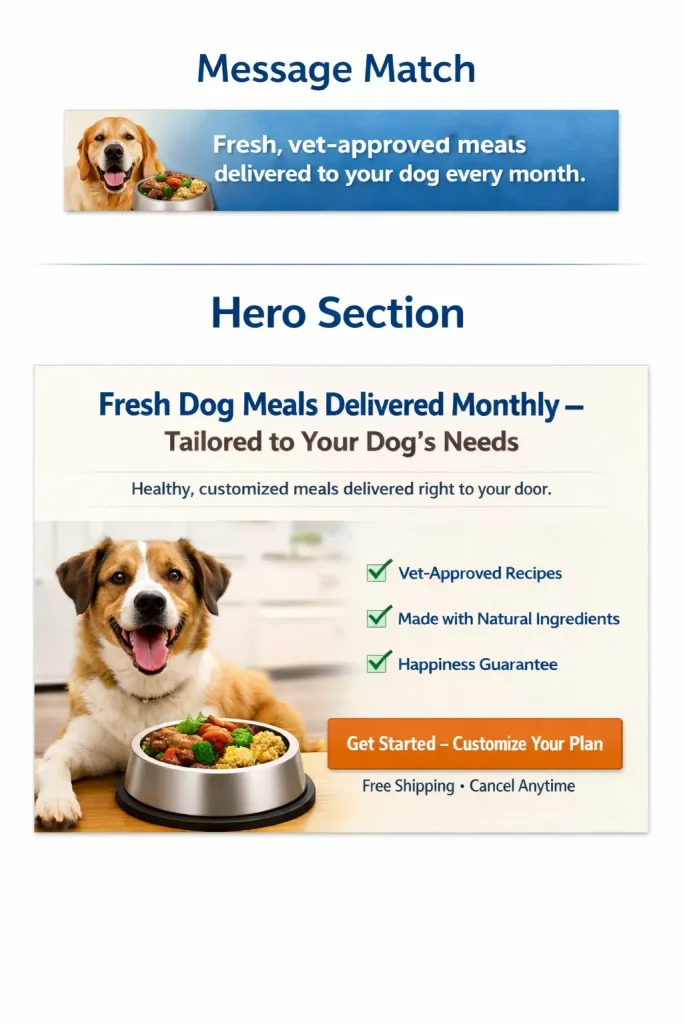
Message match means the landing page immediately confirms the promise that brought the visitor there.
If someone clicks an ad, email, or social post, they arrive with an expectation already formed. When the page continues that same message, visitors feel confident they’re in the right place. When it doesn’t, hesitation starts almost instantly.
On our dog food example, imagine the ad says:
“Fresh, vet-approved meals delivered to your dog every month.”
The landing page headline shouldn’t introduce a new idea or shift the focus to the brand story. It should reinforce the same promise:
“Fresh dog meals delivered monthly, tailored to your dog’s needs.”
Nothing surprising. Nothing clever for the sake of it. Just confirmation.
This alignment helps visitors immediately understand what’s being offered, so deciding what to do next feels straightforward.
A simple rule: the closer your headline matches the message that drove the click, the easier it is for visitors to keep moving toward conversion.
A clear hero section
The hero section is the first thing visitors see when the page loads. Its job is to make the offer clear and show what action to take next.
Visitors should be able to answer three questions within a few seconds:
What is this?
Who is it for?
What should I do now?
On our dog food landing page, the hero section includes:
A headline that clearly states the offer: monthly dog meals delivered to your door
A short supporting line explaining the benefit: vet-approved recipes, natural ingredients, etc.
A visual showing the product in context: happy dog and tasty food
A primary call-to-action button placed immediately in view: start making your plan
Nothing here is decorative. Every element helps visitors understand the offer quickly enough to decide whether to continue. If the hero section is unclear, most visitors won’t scroll far enough to see the rest of the page.
Message match to hero section congruency
Frictionless forms
Forms are where many conversions start to fail. Every additional field gives visitors another reason to stop. The longer a form feels, the more people hesitate, even if they were interested seconds earlier.
Ask only for what you genuinely need at this stage, not what might be useful later. If you’re generating leads or starting a subscription, begin with the essentials. Additional details can always be collected after someone signs up.
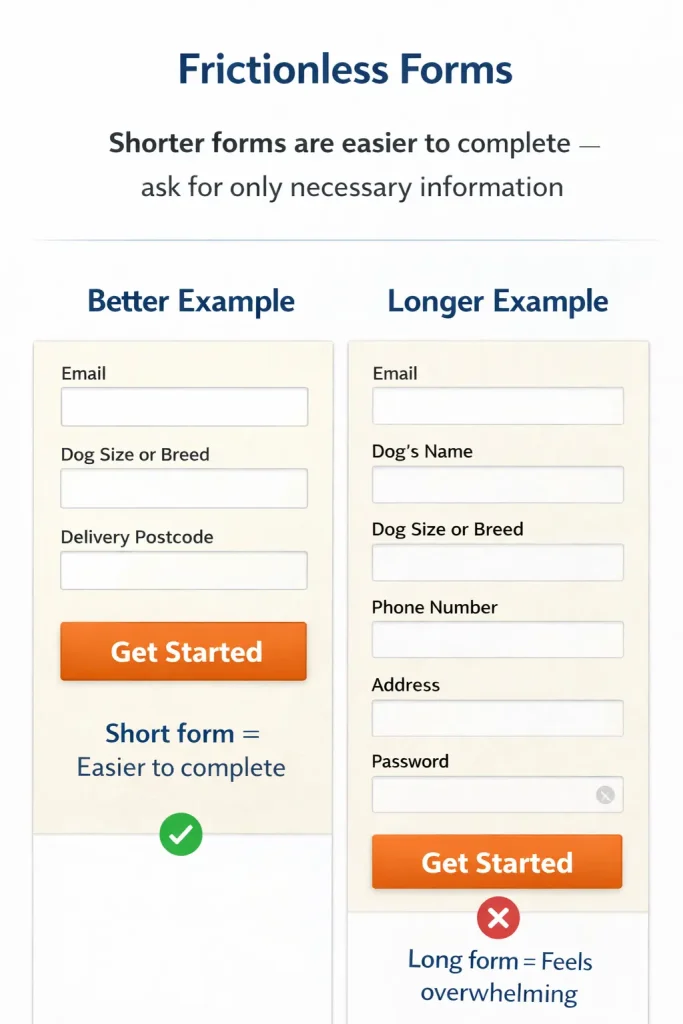
On our dog food landing page, the signup form might ask for:
Email address
Dog size or breed
Delivery postcode
That’s enough to start building a personalized plan. Asking for phone numbers, detailed preferences, or account setup information immediately would slow people down before they’ve committed.
Short, focused forms feel easier to complete, which leads to more finished signups./
Short sign-up form vs. longer signup form
Strategic trust signals
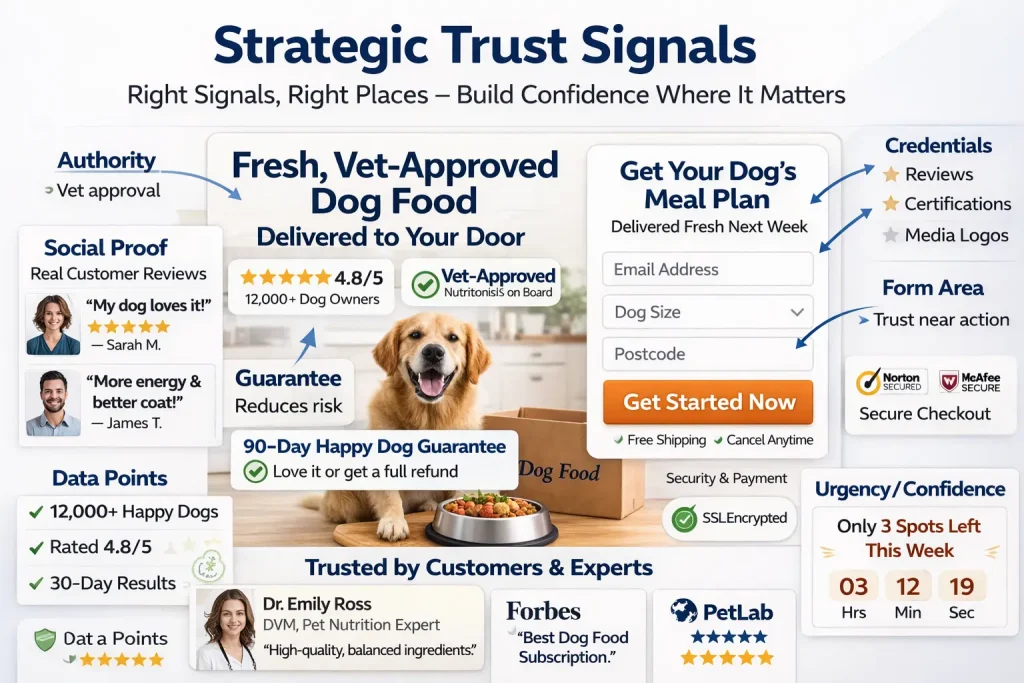
Visitors hesitate when they’re unsure whether an offer is credible or worth committing to. Trust signals and social proof help answer those doubts before they become a reason to leave.
Common trust signals include:
Customer testimonials
Specific data points or results
Short case study highlights
Recognizable customer or partner logos
Security or payment badges
Placement matters as much as the signal itself. Instead of grouping everything at the bottom of the page, position trust elements where questions naturally arise, such as near pricing details or directly beside a signup form.
On our landing page, this might look like:
Reviews from dog owners placed under the subscription pricing
A “Vet-approved recipes” badge near the headline
A short testimonial next to the signup form confirming delivery reliability or food quality
Trust signals work best when they appear exactly where visitors are deciding whether to continue.
Visual hierarchy and flow
A landing page shouldn’t feel like a wall of information.
Visitors don’t read pages from top to bottom. They scan first, trying to understand how the page is organized and where to focus their attention. Clear sections, consistent spacing, and a logical order help them understand what matters without effort.
In our example, the flow might look like this:
A clear hero section introducing the subscription
Benefits explaining why the food is different
Social proof from other dog owners
Pricing and subscription details
A signup form and call to action
Each section answers the next natural question a visitor might have. Nothing appears randomly, and nothing competes for attention at the same time.
When the structure is clear, visitors know where to look and what to do next. When everything feels equally important, people stop scanning and leave.
Strong landing pages don’t rely on more information. They rely on clear organization that helps visitors move through the page naturally.
What REALLY makes a page convert
Best practices are helpful, but conversion improvements usually come from understanding how real visitors behave on a page.
Across usability research, conversion benchmark reports, and large-scale landing page datasets, a few patterns appear consistently.
Structure matters more than copy alone
Strong copy can’t compensate for an unclear layout.
Usability research from the Nielsen Norman Group shows that users primarily scan web pages rather than read them line by line. Visitors form an initial understanding of a page within seconds, deciding whether it feels relevant before engaging with detailed content.
If the structure is unclear, most visitors never reach the copy meant to persuade them.
The one-goal rule
Landing pages built around a single action consistently outperform pages with multiple competing objectives.
According to the Unbounce Conversion Benchmark Report, higher-performing landing pages maintain a focused call to action and minimize navigation options that pull visitors away from the intended outcome.
When visitors are asked to choose between several actions, decision effort increases and completion rates typically drop.
Mirror the audience’s language
Pages that mirror customer language often perform better than those relying on polished marketing phrasing.
Research in the Journal of Consumer Research shows that concrete, customer-aligned language improves satisfaction and purchase intent, as people interpret familiar wording as evidence that a company understands their needs.
Language taken from reviews, surveys, and customer conversations tends to resonate faster because visitors immediately recognize the problem being addressed.
Strategic social proof placement
Social proof is most effective when it appears exactly where uncertainty arises.
Testing platforms such as VWO and CXLfrequently report improvements when testimonials or validation elements are placed near pricing sections, signup forms, or strong product claims rather than grouped at the bottom of a page.
Placement matters as much as the testimonial itself.
Speed does the heavy lifting
Page speed has a measurable impact on whether visitors stick around long enough to engage. Google/SOASTA research found that as load time rises from one second to seven seconds, the likelihood of a bounce increases 113%.
High-converting landing pages rarely succeed because of a single tactic. They perform well when structure, clarity, credibility, and performance all support the same goal.
Final thoughts
When visitors immediately understand what’s being offered, why it matters, and what to do next, conversions follow naturally. Structure, message alignment, focused goals, and credible signals all work together to support that decision.
The most effective landing pages aren’t louder or more complex. They remove confusion step by step, guiding visitors toward one clear action.
Instead of chasing shortcuts or dramatic redesigns, start by improving how clearly your page communicates its purpose. Small improvements in structure, messaging, and flow often produce the biggest gains over time.
FAQs
What is a good conversion rate for a landing page?
A “good” conversion rate depends on traffic intent and industry, but most landing pages convert between 2% and 6%. High-performing pages often reach 10% or more when traffic is well targeted and the offer closely matches visitor expectations.
Lead generation and webinar pages typically convert higher than ecommerce pages because the commitment required is lower.
Rather than comparing yourself to a universal benchmark, measure improvement against your own baseline over time.
Do I need a custom domain for my landing page?
No, but it usually helps.
A custom domain improves trust and brand consistency, especially for paid campaigns or lead generation offers. Visitors are more comfortable sharing information when the URL clearly belongs to a recognizable brand.
For testing or internal campaigns, hosted landing page URLs work fine. For long-term campaigns, a branded domain is generally the better choice.
How long should a landing page be to convert?
There isn’t a fixed ideal length. The right length depends on how much explanation your offer requires.
Simple offers with low commitment can convert well on shorter pages. Higher-priced or more complex products usually need longer pages that address objections, explain benefits, and build credibility.
A useful guideline is this: include enough information to answer the visitor’s likely questions, but avoid adding sections that don’t support the primary goal.
What is the difference between A/B testing and conversion rate optimization?
A/B testing is a method.. Conversion rate optimization (CRO) is the broader process.
A/B testing compares two versions of a page element, such as a headline or button, to see which performs better. Conversion rate optimization includes the full strategy behind improving performance, including research, user behavior analysis, hypothesis building, testing, and iteration.
In short, A/B testing is one tool used within a larger optimization approach.
Share this article:
Recent Posts
October 12, 2026|13 mins read
Written by Laura Clayton