


Summarize in:
Selling an online course rarely works as a one-step process. Most people don’t land on a page, read a pitch, and buy immediately. They need context, trust, and time to understand whether the course is actually right for them.
That’s where your email list comes into play.
An email list gives you a direct way to stay in touch with potential students, share useful content, and guide them toward your course when they’re ready. Unlike social platforms, you control the relationship, the message, and the timing.
We’ll walk through how to build an email list specifically for selling online courses. No growth hacks, no gimmicks, just practical steps you can use whether you’re launching your first course or improving an existing funnel.
You’ll learn how to attract the right subscribers, set up simple automation, and turn interest into enrollments without relying on constant posting or paid ads.
Key takeaways
- Email converts better than social when it comes to selling courses because it’s a direct channel you control.
- Strong email lists are built around a clear idea of who the course is for, not just traffic volume.
- Automation and segmentation help keep emails relevant without constant manual work.
- You don’t need heavy urgency, but clear timing helps people actually decide.
- Smaller, engaged lists usually sell better than large, inactive ones.
Email vs. social: Which converts better?
Social media is often where people first discover an online course, and your emails are usually where they decide whether to buy.
On social platforms, posts compete with everything else in a fast-moving feed. Reach is limited by algorithms, timing is unpredictable, and even interested followers can miss important updates.
Course launches can easily disappear between unrelated content.
Email works differently. When someone joins your list, they’re opting into direct communication. Messages land in a personal inbox, don’t vanish after a few hours, and allow more space to explain what a course covers and who it’s for.
There’s also a measurable conversion difference. Industry benchmarks consistently show that email traffic converts at higher rates than social traffic, with email campaigns often converting 2-3x better on average.
Email also tends to deliver stronger ROI, partly because you’re speaking to people who have already shown intent by subscribing.
Social still plays an important role, especially for visibility and traffic. Many course creators use platforms like YouTube or Instagram to attract attention, then direct that interest toward an email signup.
The email list becomes the place where interest turns into consideration and, eventually, a purchase.
Define your ideal student first
Before you think about tools, opt-in forms, or automation, you need to be clear about who your course is actually for.
A vague audience leads to vague messaging, and vague messaging doesn’t convert. An email list only works when the people on it recognise themselves in what you’re saying.
Start by answering a few basic questions:
- What problem is your course helping someone solve?
- What stage are they at when they join your list?
- What do they already know, and what are they confused about?
- What outcome are they hoping for after taking your course?
The more specific you can be, the easier everything else becomes.
This also helps you avoid attracting the wrong subscribers. A large list of people who are curious but unqualified will slow you down. A smaller list of people who genuinely want the outcome your course offers is far easier to convert.
Tip: How you describe your course is the best way to find your ideal students. Read our guide on how to write a course description to learn how to connect with your audience on a deeper level.
Choose the right email marketing tool
The best email marketing tool for selling online courses is the one that stays out of your way.
At a minimum, you need a platform that can collect subscribers, send emails reliably, and automate basic follow-ups.
You don’t need every feature on day one, and you definitely don’t need enterprise-level complexity before you’ve made your first sale.
When comparing tools, focus on a few practical criteria:
Ease of use
If the interface is confusing or slow, you’ll avoid using it. Course creators tend to do better with tools that make it easy to write emails, build simple automations, and see what’s working without digging through dashboards.
Automation basics
Look for support for:
- Welcome sequences
- Simple nurture flows
- Tagging or segmentation based on actions, such as link clicks or signups
You don’t need complex branching logic early on, but you do want the ability to send the right follow-up without doing it manually every time.
Segmentation and tagging
As your list grows, not everyone should receive the same message. Even basic tagging, such as “downloaded lead magnet” or “attended webinar,” makes it easier to keep emails relevant and avoid burning out your audience.
Analytics you’ll actually use
Open rates, click-through rates, and basic conversion tracking are enough for most course funnels. If a tool overwhelms you with metrics you never act on, it’s probably more than you need.
Below is a simple comparison of common email tools used by course creators. This isn’t exhaustive, but it gives a sense of how they differ at a high level.
| Tool | Best for | Strengths | Limitations |
| MailerLite | Beginners and small course launches | Simple setup, affordable pricing, solid automation basics | Less advanced segmentation |
| ConvertKit | Creators and educators | Strong tagging, creator-focused features | Higher cost as list grows |
| ActiveCampaign | More complex funnels | Advanced automation and segmentation | Steeper learning curve |
Many creators start with a simpler tool and switch later as their needs change. That’s normal. The focus at this stage isn’t perfection, it’s consistency. Pick something you’ll actually use, then focus on building the list and sending useful emails.
Once the tool is in place, the next step is giving people a good reason to subscribe in the first place.
Tip: If you’re ready to take the leap into email marketing software, check out this guide to the best email automation tools
Create a value-packed lead magnet
A good lead magnet solves a small, specific problem that your ideal student is already aware of. It shouldn’t try to teach everything or replace the course, instead, it should give a quick win and make the next step feel obvious.
When deciding what to offer, focus on relevance over size. A short resource that directly relates to your course topic will outperform a long, generic freebie every time.
Common lead magnet formats that work well for online courses include:
- A short PDF guide or checklist
- A free lesson or video walkthrough
- A template or worksheet
- A mini email or video series
- A limited preview of your paid course
The best lead magnets align closely with what you sell. If your course teaches a process, the lead magnet might cover the first step. If your course promises a transformation, the lead magnet might address the biggest early obstacle.
Clarity matters more than polish. People should understand what they’ll get and why it’s useful within a few seconds. Vague promises lead to low-quality signups, which hurt conversion later.
It also helps to think one step ahead. Ask yourself:
- What should someone understand after using/reading this?
- What problem remains unsolved?
- How naturally does the course fit as the next solution?
If the lead magnet and the course feel connected, your emails won’t need to work as hard to convince anyone.
Once you have something worth signing up for, the next challenge is making that signup easy and visible.

Design strategic opt-in forms
Even a strong lead magnet won’t perform well if people don’t see the signup or feel motivated to use it.
Opt-in forms work best when they appear at moments of intent, not just when there’s empty space on a page. Placement, timing, and wording all affect how many visitors actually subscribe.
Some common opt-in placements include:
- In-content forms placed after a relevant section of a blog post
- Sidebar forms for ongoing visibility
- Exit-intent popups triggered when someone is about to leave
- Dedicated signup boxes on resource or lesson pages
There’s no single “best” placement. What matters is matching the form to the context. A checklist offered at the end of a tutorial makes sense. A course preview offered halfway through an unrelated article usually doesn’t.
Copy also plays a bigger role than many people expect. Short, specific descriptions outperform generic calls to action. Instead of asking visitors to “join the newsletter,” explain what they’ll get and why it’s useful.
For example:
- What problem does this help solve?
- How long will it take to consume?
- Who is it meant for?
Design matters, but clarity matters more. Clean layouts, minimal fields, and a clear next step are usually enough.
Once opt-in forms are live, testing is worth the effort. Small changes to headlines, placement, or timing can make a noticeable difference. A simple A/B test on one variable at a time is usually enough to spot improvements.
After someone signs up, the experience shouldn’t stop there. What happens next often determines whether they stay engaged.
Build a high-converting landing page
A landing page exists for one reason: to get someone to sign up. That sounds obvious, but it’s where many course creators overcomplicate things. Extra links, competing messages, or vague copy make it harder for visitors to decide what to do.
A strong landing page keeps focus tight and expectations clear.
At a minimum, it should include:
- A clear headline that states the outcome or benefit
- A short explanation of who the resource is for and why it matters
- A brief description of what’s included
- A simple opt-in form
- Reassurance, such as a short bio, credibility markers, or a privacy note
The copy should stay closely aligned with the course topic. If your course teaches email automation, the landing page shouldn’t promise generic marketing growth. Misalignment leads to poor-quality subscribers who are unlikely to buy later.
You don’t need a complex design or custom graphics to get started. Even a basic layout with clear spacing and readable text can convert well if the message is strong.
Once the page is live, resist the urge to constantly rewrite it. Let it run long enough to collect data, then make changes based on actual performance rather than instinct.
With a landing page in place, the next step is deciding how you communicate with new subscribers once they join.
Tip: Ready to build? Be sure to read our step-by-step breakdown of how to build the perfect landing page and start seeing your conversions and traffic climb.
Set up automated welcome and nurture sequences
When someone joins your email list, timing matters more than volume.
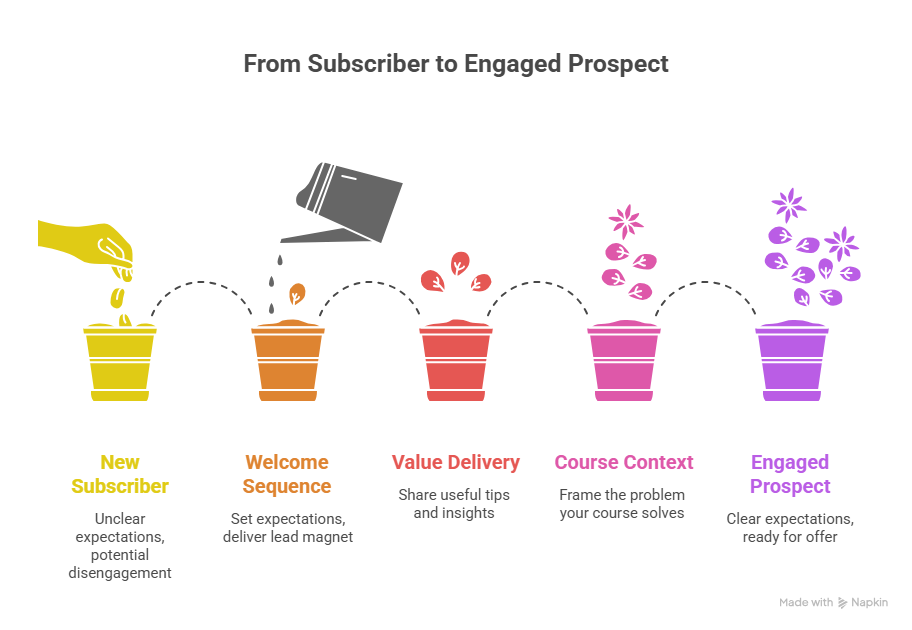
The first few emails set expectations. They show what kind of content you send, how often you show up, and whether staying subscribed is worth it. If this stage is unclear or inconsistent, even interested subscribers can disengage quickly.
A simple welcome and nurture sequence usually works better than a long, complex one.
In the first few emails, focus on three things.
Orientation
Let people know what they signed up for and what will happen next. Remind them why they joined and how the lead magnet connects to your broader topic.
Value
Share something genuinely useful. This could be a tip, an explanation, or a short example related to the course outcome. The goal is to be helpful without overwhelming them.
Context for the course
You don’t need to sell immediately, but you can start framing the problem your course solves. This helps the eventual offer feel relevant rather than abrupt.
A common structure for the first few emails looks like this:
- Email 1: Deliver the lead magnet and set expectations
- Email 2: Expand on the problem or share a practical insight
- Email 3: Introduce the course topic more directly and explain who it’s for
Personalization can improve engagement, but it doesn’t need to be complicated. Using someone’s first name or referencing what they signed up for is often enough at this stage.
The main goal of a nurture sequence isn’t pressure. It’s continuity. You’re keeping the conversation going so interest doesn’t fade between the signup and the moment someone is ready to consider the course.
After this foundation is in place, segmentation becomes much easier and far more effective.
Segment your list based on user behavior
As your list grows, treating every subscriber the same becomes less effective.
Segmentation lets you respond to what people actually do, not just when they joined. That way, people get emails that feel relevant instead of random.
Behavior-based segmentation is usually more useful than demographic data for selling courses. Actions signal intent far more clearly than age, location, or job title.
Common behaviors you can segment around include:
- Which lead magnet someone downloaded
- Which emails they opened or ignored
- Links they clicked
- Whether they visited a course or pricing page
- Whether they already purchased
Even simple segments can make a difference. For example, someone who clicked through to a course page is in a different decision stage than someone who only read educational content.
Most email tools support segmentation using tags or rules. The exact terminology varies, but the idea is the same: group people based on signals, then tailor what they see next.
With segmentation in place, the next challenge is bringing the right people into the funnel in the first place.
Drive traffic to your lead capture points
An email list only grows if people actually reach your signup pages.
Traffic doesn’t have to come from one source, and it doesn’t have to be paid. The most sustainable course funnels usually combine a few channels that match the creator’s strengths and audience.
Organic channels
Content-based traffic tends to work well for courses because it attracts people who are already looking for solutions.
Common organic sources include:
- Blog posts optimized for relevant search topics
- YouTube videos that teach or demonstrate part of the process
- Podcasts or guest interviews in your niche
- Free lessons or tutorials shared publicly
The key is alignment. Traffic performs best when the content naturally leads into the lead magnet. A tutorial should point to a related checklist. A video lesson can offer a deeper follow-up by email.
Paid channels
Paid traffic can accelerate list growth, but it’s easier to waste money if the funnel isn’t tested first.
Typical paid options include:
- Search ads targeting high-intent keywords
- Social ads promoting a lead magnet
- Retargeting ads for people who visited key pages but didn’t sign up
If you use paid traffic, start small. Validate the landing page and lead magnet before scaling spend.
Collaborations and partnerships
Borrowed audiences often convert better than cold traffic.
Guest blog posts, podcast appearances, and joint webinars introduce your course topic to people who already trust the host. These collaborations work best when the audience overlap is clear and the lead magnet genuinely adds value.
Regardless of the source, consistency matters more than volume. A steady flow of qualified traffic beats short spikes that bring in disengaged subscribers.
Once people start joining your list, trust becomes the next priority.
Use social proof to build trust
When someone is considering an online course, uncertainty is normal. Social proof helps ease that uncertainty by showing that real people have benefited from what you’re offering.
This doesn’t need to be elaborate. Even simple signals can help:
- Short student testimonials
- Results or outcomes people achieved
- Screenshots of feedback or replies
- A brief explanation of who the course has helped before
Social proof works best when it’s specific. Generic praise is easy to ignore. Concrete outcomes and clear before-and-after situations feel more believable.
If you’re launching your first course and don’t have testimonials yet, alternatives still exist. You can reference:
- Your experience teaching the topic
- Results from one-on-one clients
- Feedback from beta students or workshops
What matters here is clarity and trust, not excitement.
Incorporate incentives thoughtfully
Incentives can help move undecided subscribers to action, but they work best when they feel appropriate to the offer.
Examples include:
- Limited-time bonuses
- Extra lessons or templates
- Office hours or Q&A access
- Temporary pricing for early buyers
These don’t need to feel urgent or aggressive. Often, clarity matters more than pressure. Let people know what’s included, how long it’s available, and what happens after.
For some course creators, tools that manage timing or availability can help keep these incentives consistent across emails and pages. For others, manual setups are enough. The approach depends on how often you run promotions and how complex your funnel is.
If you do run timed bonuses or limited-access offers regularly, Deadline Funnel can help keep everything aligned. It lets you manage offer windows and availability consistently across emails and pages, without having to manually update links or timers every time.

Track, test, and adjust over time
You don’t need perfect data to improve results, but you do need to pay attention.
A few metrics are usually enough:
- Email open rates and click-through rates
- Landing page conversion rates
- Subscriber-to-student conversion
- Unsubscribe or inactivity trends
Instead of changing everything at once, test small adjustments. Over time, these incremental changes compound.
Want to see how those small conversion tweaks impact your bottom line? Plug your current numbers into our free Funnel ROI Calculator below:
Maintain and clean your list regularly
Removing inactive subscribers keeps deliverability healthy and makes your metrics easier to trust. In many cases, a smaller, engaged list will outperform a much larger one when it comes to course sales.
When the list is clean, it’s also easier to see what’s working and what isn’t.
At the end of the day, email works best when it stays relevant. Bring in the right people, send useful content, and be clear about the next step. Everything else is fine-tuning.
Conclusion
Building an email list to sell online courses is less about tactics and more about alignment.
When the right people join your list, the content they receive makes sense, and the course fits the problem they’re trying to solve, selling doesn’t feel forced. It feels like a natural next step.
Most of the work happens upfront. Defining the ideal student, creating a useful lead magnet, and setting up a clear follow-up flow do more for long-term results than any single tool or campaign. Once those foundations are in place, small improvements compound over time.
Email works well for courses because it supports context, continuity, and trust. Used thoughtfully, it gives potential students the space to understand the value of what you’re offering and decide when it’s right for them.

