


TL;DR
Campaign monitoring is the ongoing process of tracking a marketing campaign while it runs. By watching the right KPIs in real time, you can spot problems early, adjust targeting or spend, and learn which messages and channels perform best. The metrics that matter depend on the campaign, from conversions and ROI to sentiment and media mentions.
Launching a marketing campaign is only the beginning. Once it’s live, you need to know whether people are seeing it, engaging with it, and taking the action you intended.
Campaign monitoring gives you that visibility while there’s still time to act. Instead of waiting until the campaign ends to find out what worked, you can catch underperforming channels, shifts in audience response, or unexpected opportunities as they happen.
Below, we’ll look at what campaign monitoring involves, which metrics are worth watching, and how to build monitoring into campaigns from the start.
Key takeaways
- Campaign monitoring tracks performance while a campaign is still running, while campaign analysis looks back at the results afterward.
- The right metrics depend on the campaign goal and channel, with KPIs taking priority over secondary metrics.
- Monitoring can reveal problems early enough to adjust targeting, messaging, budget, or other parts of a live campaign.
- Native analytics work well for individual channels, while broader campaigns may require multiple tools or a dedicated monitoring solution.
- Secondary metrics can reveal patterns that improve future campaigns even when they aren’t directly tied to the primary goal.
What is campaign monitoring?
Campaign monitoring is the ongoing, real-time tracking of a marketing or PR campaign’s performance against the goals set before launch.
It applies to any channel, not just email, and happens while the campaign is still live, so problems and opportunities can be caught before the budget runs out.
Campaign monitoring vs. campaign tracking vs. campaign analysis
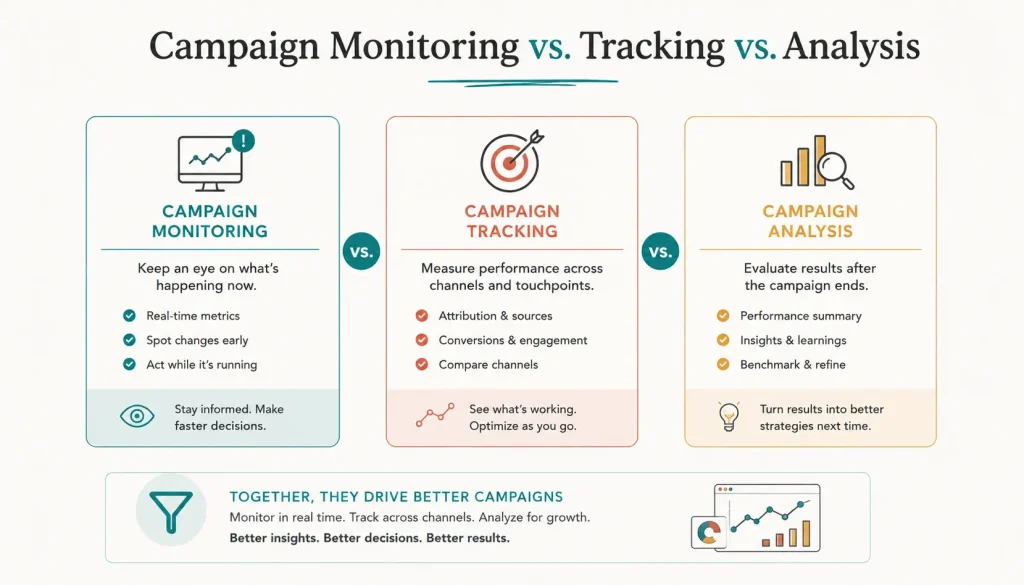
These three terms get used interchangeably, but they describe different stages of the same work.
Campaign tracking is the mechanical part, and includes setting up UTM parameters, pixels, and integrations so data actually gets captured in the first place. Without tracking in place, there’s nothing to monitor.
Campaign monitoring is what you do with that data while the campaign is still running. It’s live and ongoing, checking metrics day to day (or minute to minute, if you’re watching a PR crisis unfold) to see whether things are on course.
Campaign analysis happens after the campaign ends. It’s the retrospective study of what worked, what didn’t, and why, usually feeding into the strategy for the next campaign.
Despite clear definitions, the lines can blur in real life. A good campaign monitoring setup depends on solid tracking, and the insights you catch mid-campaign often become the analysis you write up afterward.
Most teams use “monitoring” and “tracking” as near-synonyms day to day, and that’s fine as long as everyone understands the difference between watching a campaign live and reviewing it after the fact.
Why campaign monitoring matters
Campaign monitoring can influence both the campaign you’re running now and the decisions you make about future ones.
Improve campaigns while they’re running
Monitoring shows you when a campaign is underperforming while there’s still time to do something about it.
You can catch broken links or sudden drops in engagement, move budget toward better-performing channels, and refine targeting based on which audiences and messages are actually converting.
Understand your audience
Campaign data shows you what people respond to instead of what you expected them to respond to.
Over time, patterns across messages, channels, formats, and audience segments can give you a much clearer picture of what drives engagement and conversions.
Make better decisions next time
What you learn doesn’t stop being useful when the campaign ends. Monitoring gives you benchmarks for future campaigns and makes it easier to identify what worked before.
It also makes you more responsive to changes happening now, whether that’s shifting audience sentiment or a competitor making a move.
What metrics should you monitor?
The metrics worth monitoring depend on what the campaign is supposed to achieve. A lead generation campaign might prioritize conversion rate and cost per acquisition, while reach and engagement are more relevant to brand awareness.
Your key performance indicators (KPIs) are the metrics tied most closely to that goal. Monitor those first, then use secondary metrics to understand what’s driving the results.
Core performance metrics
| Metric | What it measures |
| Click-through rate (CTR) | The percentage of people who click a link after seeing your content, ad, or email. |
| Open rate | The percentage of delivered emails that recipients open. |
| Conversion rate | The percentage of people who complete the intended action, such as making a purchase, signing up, or downloading a resource. |
| Engagement rate | Interactions such as likes, comments, shares, and saves relative to your audience or reach. |
| Bounce rate | Depending on the channel, emails that couldn’t be delivered or website visitors who leave without further interaction. |
| Return on investment (ROI) | The value or revenue generated compared with the amount spent on the campaign. |
| Close rate | The percentage of leads or prospects that become customers. |
| Impression share | The percentage of eligible impressions your ads actually receive. |
| Cost per acquisition (CPA) | The average amount spent to acquire a customer or lead. |
| Customer lifetime value (CLV) | The estimated value a customer generates over their relationship with your business. |
| Organic reach | The number of people who see your content without paid promotion. |
PR & media monitoring metrics
Campaigns that generate press coverage, influencer mentions, earned media, or organic social conversation need another layer of monitoring. These metrics track what people are saying about the campaign and how far that conversation spreads.
| Metric | What it measures |
| Share of voice | Your share of the conversation within a market or category compared with competitors. |
| Sentiment | Whether coverage and conversations about your brand or campaign are positive, negative, or neutral. |
| Reach and impressions | The potential audience exposed to media mentions, social posts, and other coverage. |
| Media mention volume | How often your brand, product, or campaign appears across news and social sources. |
| Message pull-through | How consistently your key campaign messages appear in press, influencer, or other earned coverage. |
| Earned media value | An estimate of what comparable exposure would have cost through paid advertising. |
These metrics matter most for PR and integrated campaigns, where a big part of the impact happens outside channels you directly control. You can’t A/B test a journalist’s headline, but you can monitor how it lands.
Should you only measure KPIs?
KPIs should be the priority, but secondary metrics are worth tracking too. They can provide context for your results and reveal patterns you can use in future campaigns.
Say conversion rate is the primary KPI for an email campaign. Open rate is still worth tracking. Compare open rates across campaigns and you may find that certain subject-line lengths, phrasing, or levels of urgency consistently perform better.
That insight may not determine whether the current campaign succeeded, but it gives you something concrete to test in the next one.
How to monitor campaigns effectively
Plan your monitoring before the campaign launches. Set the goals, choose the KPIs, and confirm that you can collect the data you need. After the campaign is live, you’ll have a baseline for judging performance and can respond to changes as they happen.
Step-by-step monitoring framework
- Set goals and KPIs: Define the campaign goal and choose the metrics you’ll use to measure progress.
- Choose your tools: Use native analytics for individual channels and additional monitoring tools when you need data across channels, earned media, or social conversations.
- Monitor performance: Check your KPIs throughout the campaign and watch for significant changes or unexpected results.
- Create reports: Bring the relevant data together so your team can see how the campaign is performing.
- Look for trends: Compare results across audiences, channels, messages, and time periods to identify patterns.
- Make adjustments: Use the findings to change targeting, messaging, budget allocation, or other campaign elements when needed.
Manual vs. automated monitoring
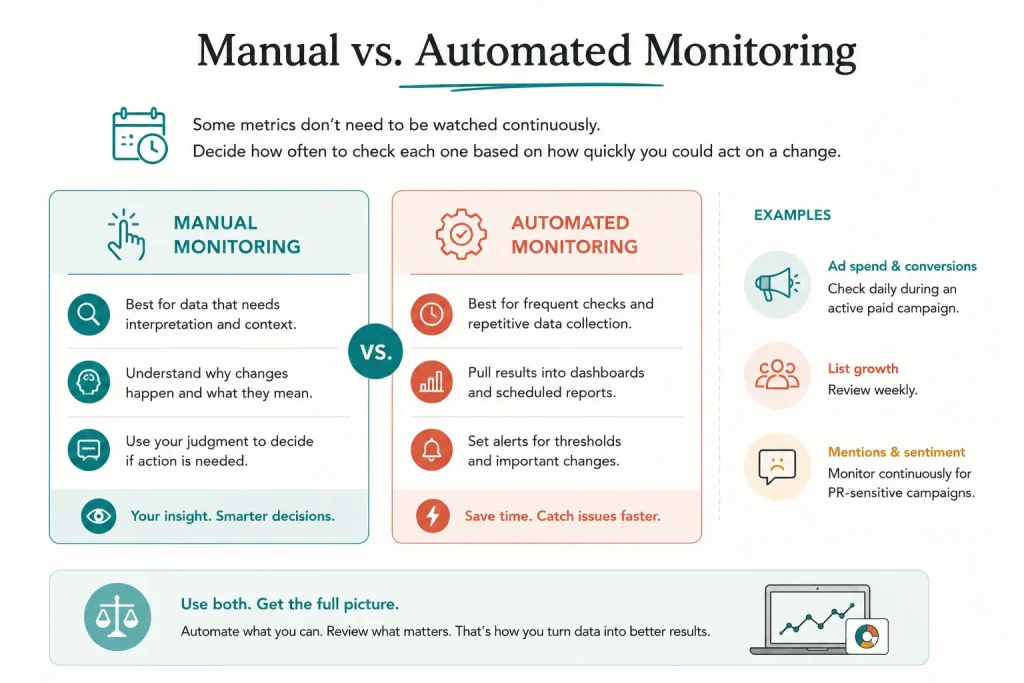
Some metrics don’t need to be watched continuously. Decide how often to check each one based on how quickly you could realistically act on a change.
For example, ad spend and conversion data may deserve a daily check during an active paid campaign. Weekly reviews may be enough for slower-moving metrics such as list growth. Brand mentions or negative sentiment may need continuous monitoring if a campaign has a PR component.
Automate the parts that depend on frequent checks or repetitive data collection. This could include pulling results into a shared dashboard, scheduling reports, or setting alerts for specific thresholds.
Keep manual reviews for data that needs interpretation, such as why conversions dropped or whether a change in sentiment actually requires a response.
Real-time alerts and crisis response
Set alerts around specific conditions that someone needs to act on, rather than every fluctuation in campaign data. Too many alerts make important changes easier to miss.
Useful triggers might include:
- Spend reaching a predefined limit
- Conversion rate dropping significantly below its normal range
- A landing page or campaign link failing
- A sudden increase in negative mentions
- An unusual spike in campaign traffic or engagement
- Press coverage or a high-profile account mentioning the campaign
Decide who receives each alert and what they should check first. A notification is much more useful when the recipient already knows whether they’re expected to pause an ad, check a landing page, contact the PR team, or simply investigate further.
Campaign monitoring tools
Build your monitoring setup around the data you need instead of looking for one tool that covers everything. Start with the platforms already involved in the campaign, then identify what they can’t show you.
For a paid social campaign, for example, the ad platform may provide spend, impressions, clicks, and conversions. Website analytics can show what those visitors do after clicking. Your CRM can show whether those conversions eventually become customers.
If the campaign also generates organic discussion or press coverage, you’ll need another source for mentions and sentiment.
Before adding a tool, check:
- Data coverage: Does it track the channels and metrics tied to your KPIs?
- Update frequency: Is the data available quickly enough for you to act on it?
- Segmentation: Can you separate results by campaign, channel, audience, location, or other relevant dimensions?
- Alerts: Can you choose the conditions that trigger a notification?
- Reporting: Can you combine and export the data in a format your team can actually use?
- Integrations: Can it exchange data with your analytics, CRM, advertising, or reporting tools?
Native and built-in analytics
Get started with native analytics before paying for additional software. Facebook Ads Manager and similar advertising dashboards already provide detailed information on spend, reach, clicks, conversions, audiences, and individual ads. Email platforms typically provide delivery, open, click, conversion, unsubscribe, and list data.
Use UTM parameters when traffic leaves those platforms. Consistent campaign, source, and medium parameters let you separate traffic in your website analytics and compare channels without relying solely on each platform’s attribution.
Native analytics become less convenient when you need to answer questions that cross systems. An ad platform might tell you that an ad generated 100 leads, for example, while your CRM shows that only five became customers.
Looking at either number alone gives you a very different impression of campaign performance.
Campaign monitoring by channel
Each channel gives you a different view of campaign performance, so the metrics you prioritize will change depending on where the campaign runs.
Email campaigns
For email campaigns, monitor open rate, click-through rate, conversion rate, unsubscribe rate, and list growth. Opens and clicks show how recipients respond to your emails, while conversions connect that engagement to the campaign goal.
Keep an eye on unsubscribes and list growth as well. A campaign that generates plenty of clicks but causes an unusual number of people to leave your list may need a closer look.
Social media campaigns
Social media campaigns typically rely on engagement, reach, hashtag performance, sentiment, and share of voice. Track these metrics across the campaign rather than judging performance by a single post.
Sentiment and share of voice add context to engagement figures. A campaign generating thousands of mentions isn’t necessarily performing well if much of the conversation is negative.
PR and integrated campaigns
For PR campaigns, track media mentions, coverage quality, message pull-through, reach, and earned media value. These metrics show how widely the campaign is being discussed and whether coverage reflects the messages you intended to communicate.
Integrated campaigns require a wider view. Compare PR and media results with performance across email, social, paid advertising, and other channels involved in the campaign.
Common campaign monitoring mistakes to avoid
A monitoring setup can collect plenty of data without giving you much useful information. Watch out for these common problems:
- Prioritizing vanity metrics: Large impression or follower numbers can look impressive in a report, but they matter less if they aren’t connected to the campaign goal.
- Setting up monitoring after launch: Choose your KPIs, benchmarks, and tracking methods beforehand so you can measure performance from the beginning.
- Ignoring earned and social activity: Data from your owned and paid channels won’t capture every conversation happening around a campaign.
- Tracking without benchmarks: Compare results with campaign targets, previous campaigns, or relevant industry benchmarks to give individual metrics context.
- Collecting data without acting on it: If performance changes significantly, investigate why and decide whether the campaign needs an adjustment.
- Keeping data in separate silos: Compare results across channels so one dashboard doesn’t hide a problem or opportunity happening elsewhere.
Turn campaign monitoring into better campaigns
Campaign monitoring gives you information you can use while a campaign is still running. Track the metrics connected to your goals, compare results across channels, and investigate significant changes instead of waiting until the final report.
Keep those results after the campaign ends, too. They provide benchmarks for future campaigns and a record of which audiences, messages, channels, and tactics performed best.
Running an evergreen campaign with a limited-time offer? Deadline Funnel lets you create personalized deadlines for each lead, so you can add genuine urgency to the campaign and track how it affects conversions.
Frequently asked questions
What is campaign monitoring in simple terms?
Campaign monitoring is the process of checking how a marketing or PR campaign performs while it’s running. Teams monitor metrics such as engagement, conversions, costs, and reach to identify changes and make adjustments before the campaign ends.
What’s the difference between campaign monitoring and campaign tracking?
Campaign tracking is the process of collecting campaign data through methods such as UTM parameters, tracking pixels, and platform analytics. Campaign monitoring involves reviewing that data while the campaign is running to evaluate performance.
Which metrics are most important to monitor?
Start with the KPIs tied directly to your campaign goal. A sales campaign might prioritize conversion rate and CPA, while a social campaign may prioritize engagement and reach. Secondary metrics can then provide more context about the results.
What tools are used for campaign monitoring?
Campaign monitoring can use native analytics from advertising, email, social media, and other marketing platforms alongside website analytics and specialized monitoring tools. The right setup depends on the channels involved and the data you need to collect.


