Summarize in:
TL;DR (Quick Answer)
How do you optimize content for AI search (AEO) in 2025?
Digital products let you create something once and sell it repeatedly, but most first-time creators fail because they skip validation, underprice their work, or rely on platforms that limit their growth. The most reliable path is to validate demand first, price based on outcomes, choose a platform that gives you control, and build an audience before you launch.
Anyone researching how to create digital products runs into the same promise: build something once, sell it repeatedly, and avoid the headaches that come with physical products.
There’s no inventory to manage, no shipping delays, and no customer emails about lost packages. Once a digital product is finished, delivery can happen automatically through a checkout page, download link, or email sequence.
Scalability is what makes digital products appealing. An e-book, template, online course, or software tool can keep generating revenue long after it’s created, without additional work for every sale.
But most first-time creators run into the same problems. They spend weeks building products nobody asked for, price them too low, or rely entirely on marketplaces that limit their access to customer relationships and long-term growth.
This guide explains the process step by step, from finding and validating an idea to pricing, selling, and building a funnel that consistently drives sales.
Key takeaways
- Platform fees add up quickly, especially on marketplaces that take a percentage of every sale
- Relying on marketplaces alone limits growth because you don’t own customer relationships
- Pricing based on outcomes consistently outperforms pricing based on effort
- Underpricing is more common than overpricing and can signal lower value to buyers
- Building an audience before launch matters more than the product itself
- Most first-time creators fail because they skip validation, not because of execution
The benefits of selling digital goods
Digital products have become one of the most accessible online business models because they’re inexpensive to launch, scalable, and relatively simple to automate once the system is in place.
Some of the biggest advantages include:
- Low startup costs: Most digital products can be created with inexpensive or free tools like Google Docs, Canva, or Loom.
- High profit margins: After the product is created, there are usually no manufacturing or shipping costs tied to each additional sale.
- Global reach: A customer can buy and access your product instantly from anywhere with an internet connection.
- Flexible product formats: You can sell everything from templates and guides to memberships, courses, software, and premium resources.
- Automated delivery: Checkout pages, email sequences, and download systems can handle fulfillment automatically.
- Scalable income potential: Unlike services, digital products aren’t directly tied to your available hours.
That said, the business model works best when the product solves a clear problem for a specific audience. The creators who succeed usually focus less on “passive income” and more on building something genuinely useful.
What counts as a digital product (and why the model works)
A digital product is anything a customer receives digitally, including downloadable files, streamed content, or resources accessed through a login. Nothing ships. Nothing restocks.
Once a customer completes a purchase, fulfillment happens automatically through a checkout page, download link, or email sequence. Unlike physical products, the same product can be sold repeatedly without additional manufacturing or shipping costs.
The trade-off is upfront work. Before anything becomes scalable, you still need to create the product, validate demand, and get it in front of real buyers.
Now, let’s get into how you can start making and selling your own.
Step 1: Finding your profitable digital product idea
The strongest digital product ideas usually come from problems people already want solved.
Instead of trying to invent something completely new, focus on questions you hear repeatedly, tasks people struggle with, or systems you already use in your own work.
The more specific the problem, the easier it becomes to create messaging, attract the right audience, and convince people the product is worth paying for.
Most digital products fall into a few clear categories.

Types of digital products
The written word
Written digital products have one of the lowest barriers to entry because they mostly rely on knowledge and organization rather than technical skill.
These products could be:
- E-books
- Step-by-step guides
- Swipe files
- Checklists
- Worksheets
- Templates
They work especially well for writers, educators, consultants, and creators who can explain a process clearly.
A short, focused guide that solves one specific problem will usually outperform a broad “ultimate guide” covering everything at once.
Visual assets
Visual digital products are popular because buyers can use them immediately without much setup.
Common examples include:
- Social media templates
- Brand kits
- Presentation decks
- Lightroom presets
- Printable artwork
- Stock photography
These products work well for designers, photographers, marketers, and other creative professionals.
Templates are often a strong starting point because they are relatively fast to create while still offering clear value to buyers trying to save time.
Structured learning
Educational products typically require more upfront work, but they also support higher pricing.
This category includes:
- Online courses
- Workshops
- Webinars
- Membership communities
- Coaching resources
The online learning market continues to grow rapidly, with the global e-learning industry projected to surpass $300 billion. (globalgrowthinsights.com)
The strongest educational products focus on helping a specific audience achieve a measurable outcome rather than covering a topic broadly.
Tech & utility
Tech-focused digital products solve operational or organizational problems.
Examples include:
- Notion dashboards
- Spreadsheet systems
- Calculators
- Automation templates
- SaaS tools
- Productivity systems
These products are especially effective when they help users save time, cut down repetitive work, or organize complex processes more efficiently.
You don’t need to build software to enter this category. Simple systems and templates often perform extremely well because they are easier to implement and more affordable for buyers.
Before choosing an idea, spend time looking for patterns in places where your audience already talks:
- Comments on social posts
- Questions in Reddit communities or Facebook Groups
- Client conversations
- Support emails
- Recurring frustrations in your own work
If the same question appears repeatedly, there is usually demand behind it.
Specificity also matters more than most creators expect.
Which do you think will be more appealing?
| Generic idea | Specific version |
| Social media marketing guide | Instagram Reels for independent coffee shops |
| Productivity template | Notion system for freelance designers managing client work |
| Fitness e-book | 20-minute mobility routine for desk workers with back pain |
The more clearly someone can recognize themselves in the product description, the easier it becomes to convert attention into sales.
Step 2: Validating your idea before building
One of the biggest mistakes first-time creators make is building a product before confirming there is real demand for it.
Validation matters more than polish early on. A simple product people already want will usually outperform a highly polished product nobody asked for.
Before spending weeks creating content, test interest with a small “smoke test.”
This usually means creating a simple landing page describing the product and inviting people to:
- Join a waitlist
- Sign up for updates
- Request early access
- Preorder the product
Even a basic page can tell you a lot. If nobody clicks, signs up, or responds, the positioning or idea may need adjustment before you invest more time building.
You can also validate demand by:
- Offering a discounted beta version
- Selling preorders before launch
- Sharing the idea with your audience
- Sending surveys to existing subscribers
- Testing different headlines or positioning angles
Even a small amount of early interest is more useful than building an entire product in private and hoping people buy it later.
Tip: Looking for more ideas to get started? Read our guide to the most profitable digital products to get inspired.
Step 3: Create your first version without overcomplicating it
Most first-time creators spend too much time polishing their product instead of getting it in front of real buyers.
Your first version doesn’t need custom branding, advanced automation, or a complicated members area. It just needs to solve one clear problem well enough that someone would pay for it.
A focused, useful product launched quickly will teach you more than months spent perfecting something in private.
Start small:
- A short guide instead of a 50-page e-book
- A simple Notion template instead of a full productivity system
- A workshop instead of a multi-module course
- A single resource pack instead of an entire membership library
You can improve the product later based on real feedback. Trying to build the “final version” immediately usually slows down the launch and makes it harder to adapt once customers start responding.
The technical side is also simpler than most beginners expect. A small set of accessible tools is enough to create, design, and deliver most digital products.
| What you need | Recommended tools | Best used for |
| Writing and content creation | Google Docs, Notion | E-books, guides, worksheets, outlines |
| Design and formatting | Canva | Covers, templates, PDFs, social graphics |
| Video recording | Loom, OBS | Tutorials, webinars, course modules |
| File storage and delivery | Google Drive, Dropbox | Downloads and bonus resources |
| Payments and checkout | Gumroad, ThriveCart, Podia | Selling and delivering products |
| Email marketing | beehiiv, ConvertKit, MailerLite, Deadline Funnel | Audience building and launch emails |
The important part is not the tool itself. Most creators don’t fail because they picked the wrong software. They fail because they stay stuck researching tools instead of launching the product.
Step 4: Choosing your sales platform
Where you sell your digital product matters more than most creators expect. The platform you choose affects your profit margins, customer experience, and how much control you have over your business long term.
Most creators sell through either marketplaces or platforms they control themselves.
Marketplace platforms
Marketplaces and hosted selling platforms make it easy to launch quickly. You can upload a product, create a checkout page, and start accepting payments without much technical setup.
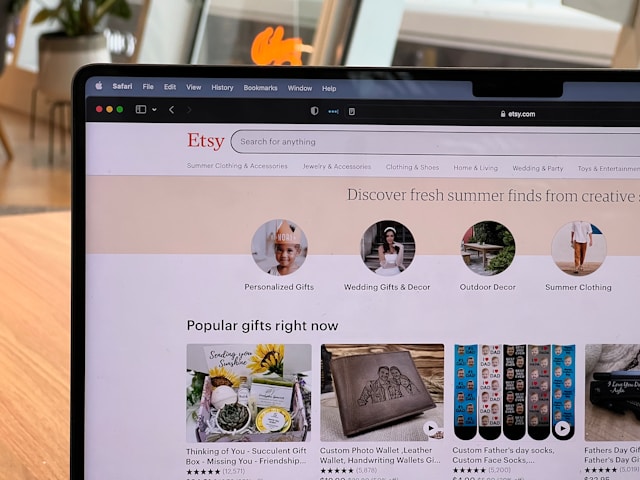
Platforms like Gumroad, Etsy, Podia, and Creative Market are popular because they simplify the launch process and let you start selling almost immediately.
But there are trade-offs:
- Platform fees eat away at margins
- Competition is often high
- Branding options can be limited
- Customer relationships are partially controlled by the platform
That last point matters the most. If you don’t own the customer relationship, building long-term revenue becomes much harder.
Tip: Are you thinking about selling on Etsy? Check out our guide to selling digital products on Etsy for more specific advice.
Owned platforms and direct sales
Selling through your own setup gives you more control over pricing, communication, and long-term growth.
Some creators use hosted checkout tools like ThriveCart or Shopify, while others sell through newsletter platforms, landing pages connected to email lists, or personal websites with integrated checkout systems.
The main advantage is ownership. You keep control of:
- Customer email addresses
- Purchase history
- Audience data
- Future communication and upsells
That becomes increasingly valuable as your product catalog grows. Instead of relying entirely on marketplace traffic, you can build repeat business through your own audience and marketing funnel.
What should beginners choose?
For a first product, simplicity matters more than flexibility.
A platform like Gumroad or Podia is usually enough to validate an idea, process payments, and deliver files without spending days setting up a website or advanced automation.
That kind of setup works well when:
- You are launching your first product
- You don’t have an existing audience yet
- You want to test demand quickly
- You are selling lower-priced products like templates or guides
As sales grow, most creators eventually move toward platforms and funnels they control more directly.
That often means connecting checkout pages to an email platform, building dedicated landing pages, and creating automated follow-up sequences for upsells or future launches.
Step 5: Pricing strategies
Pricing is one of the easiest places to lose money when selling digital products. Many first-time creators price based on how long the product took to make instead of the value it delivers to the buyer.
That usually leads to underpricing.
If your product helps someone save time, make money, stay organized, learn a skill faster, or solve a frustrating problem, that outcome matters more than the number of hours spent creating it.
Low pricing can also create the wrong perception. Buyers often associate extremely cheap products with lower quality, especially in crowded markets filled with generic templates and AI-generated content.
Most creators are better off starting slightly higher than they feel comfortable with and adjusting later based on customer feedback and conversion data.
There are a few common pricing strategies that work especially well for digital products.

Three digital product pricing strategies
Value-based pricing
Value-based pricing focuses on the result the customer gets from the product.
A $49 template that saves a freelancer several hours each week can feel inexpensive compared to the time it saves. A course that helps someone land clients or improve a business process can justify significantly higher pricing because the outcome is more valuable.
A value-based approach usually performs better than calculating a price based purely on effort or production time.
Tiered pricing
Tiered pricing gives buyers multiple options at different price points.
A creator might offer:
- A basic version with core resources
- A premium version with bonuses or templates
- A higher-tier package with coaching, workshops, or community access
This strategy works well because it captures different budget levels while also increasing the average order value from customers willing to spend more.
Freemium products
Freemium products help build trust before asking someone to buy.
This usually means offering a free resource like:
- A checklist
- A mini template
- A short guide
- A webinar
- An email course
The free product attracts potential buyers and gives them a reason to join your email list. From there, you can introduce paid products through automated email sequences and follow-up offers.
Pricing is rarely perfect on the first attempt. Most successful creators refine pricing over time based on customer behavior, conversion rates, and feedback instead of trying to find the “perfect” number immediately.
Step 6: Marketing your digital product
Creating a digital product is only half the job. Even strong products struggle to sell if nobody sees them at the right moment.
One of the biggest mistakes creators make is assuming a few social posts or a link in a bio are enough to generate consistent sales. Most successful digital product businesses rely on systems, not occasional promotion.
A simple marketing funnel is usually more effective than trying to post everywhere at once.
In most cases, the process looks something like this:
- Share useful free content that attracts the right audience
- Offer a lead magnet related to the product
- Collect email subscribers
- Build trust through email sequences and educational content
- Introduce a paid offer with a clear reason to act
Email marketing plays a major role because it gives you direct access to your audience. Social platforms change constantly, but an email list remains something you control.
It also creates opportunities to automate parts of the sales process. Instead of manually promoting your product every day, you can build evergreen funnels that continue generating
sales over time.
For example, someone might:
- Download a free checklist
- Receive a short educational email sequence
- Get introduced to a paid template, course, or workshop
- Receive follow-up emails with testimonials, bonuses, or case studies
That system works because it builds familiarity before introducing a paid offer.
Timing also matters. Without a clear deadline, many buyers postpone the decision and never come back. That is why evergreen funnels often use expiring bonuses, enrollment windows, or limited-time offers to encourage action.
With Deadline Funnel, you can run these campaigns automatically by syncing authentic deadlines across emails, landing pages, and checkout flows. This makes it possible to add urgency to evergreen funnels without manually managing launches or relying on fake countdown timers.
Start a 14 day free trial and see how Deadline Funnel can help boost conversions.
You also don’t need to dominate every platform at once. Consistency on one or two channels combined with a strong email funnel will usually outperform scattered marketing efforts across multiple platforms.
Common mistakes to avoid
Most mistakes in digital products are predictable. They’re not about skill, but about skipping the basics.
Here’s what to watch for:
- Building before validating demand
- Choosing platforms that limit access to customer data
- Underpricing to “make it easier to buy”
- Launching without an audience
- Using disconnected tools that break the checkout or delivery experience
- Ignoring onboarding after purchase
- Treating the product as finished instead of improving it over time
These issues don’t usually show up right away, but they compound. Fixing them early makes everything else easier, from sales to retention.
Conclusion
Selling digital products is one of the most accessible ways to build an online business, but success usually comes from solving a specific problem well, not from chasing passive income trends.
The creators who grow consistently tend to follow the same pattern. They validate ideas before building, launch simple first versions, price based on value, and focus on building direct relationships with their audience instead of relying entirely on marketplaces or social algorithms.
You don’t need a massive audience, expensive software, or a perfect product to start. One useful product, a clear offer, and a simple marketing funnel are enough to get real feedback and generate your first sales.
Launch the smallest version that solves a real problem, improve it based on customer response, and build from there.
FAQs
What is the easiest digital product to create?
Templates and short guides are usually the easiest. They’re quick to produce, don’t require complex tools, and can be sold at lower price points while you learn what your audience responds to.
How much does it cost to create a digital product?
Very little. Most tools like Google Docs, Canva, and Loom have free plans. Your main investment is time, not money.
Where can I sell my digital downloads for free?
Platforms like Gumroad and Podia let you start without upfront costs. They take a percentage of each sale instead. This makes them useful for testing early ideas.
Can I sell digital products without a website?
Yes. You can use platforms like Gumroad or sell directly through a newsletter. A website helps long-term, but it’s not required to get started.