


Summarize in:
TL;DR (Quick Answer)
Selling digital products on Etsy in 2026 is less about passive income and more about execution. The platform is crowded, buyers are more selective, and generic listings get buried. Sellers who are still gaining traction are the ones choosing a clear niche, creating products with a specific use case, making them easy to customize or use, presenting them well, and improving over time based on search data and customer feedback.
Selling digital products on Etsy is simple in theory. No inventory, no shipping, no overhead. Create a file once, upload it, and get paid over and over again.
That part is true. But, it’s also the reason the platform is more competitive than ever. The days of uploading a few generic printables and watching sales roll in are mostly gone.
Buyers are more selective, the marketplace is saturated with low-effort listings, and AI-generated content has made it even harder to stand out. If your product looks like everything else, it will get buried.
At the same time, the opportunity is still very real. Shops that focus on quality, niche positioning, and thoughtful design are still building consistent, scalable income from digital downloads.
If you want traction in 2026, you need to approach this differently. We’ll cover what’s actually working right now, what buyers expect, and how to build a shop that doesn’t get lost in the noise.
Key takeaways
- The Etsy market is crowded, but demand is still strong for well-positioned products
- Buyers now expect specific, problem-focused products rather than generic designs
- Top-performing categories include planners, business templates, event materials, creative assets, and creator tools
- Products that are editable, customizable, or immediately usable convert better
- Listings need strong visuals, clear descriptions, and easy-to-understand value to convert
- Most successful shops focus on one niche and build depth instead of selling unrelated products
- Early growth is slow, and traction comes from testing, iteration, and consistency
The 2026 landscape: what buyers want now
The Etsy market is still massive, but it’s no longer easy. The platform now has over 86 million active buyers and more than 8 million sellers, which means you’re not just competing on quality, you’re competing on visibility.
At the same time, overall marketplace growth has slowed compared to the pandemic boom. That’s pushed both Etsy and its sellers towards quality over quantity.
This is how the situation looks now:
The market is saturated with low-effort listings
The biggest shift over the past two years is simple. Supply exploded.
AI tools, Canva templates, and “passive income” tutorials have made it easier than ever to create digital products. The result is a flood of nearly identical listings, especially in categories like planners, wall art, and generic printables.
Etsy is a search-driven marketplace. Around 90% of purchases start with a search, and the platform is designed to match listings to specific buyer queries. This means buyers aren’t browsing randomly; they’re searching with intent, often using detailed, long-tail keywords to find exactly what they need.
If your product looks like everything else, it disappears.
Tip: Etsy isn’t the only place you can sell digital products. Take a look at our guide to the most profitable digital products in 2026 and where to sell them.
Personalization is no longer optional
Across e-commerce, personalization has become a baseline expectation. Around 71% of consumers prefer buying from brands that offer personalized experiences, and that trend carries directly into Etsy.
That’s why:
- Editable Canva templates outperform static PDFs
- Customizable planners beat fixed layouts
- Flexible designs convert better than rigid ones
Buyers don’t just want a product anymore. They want control over it.
Bundles are outperforming single products
Pricing pressure is real. Most single digital downloads are priced relatively low, often in the $5-$10 range depending on the product type, which makes it hard to scale unless you’re selling at volume.
The shift:
- Single item → low perceived value
- Bundled products → higher conversion + higher order value
Sellers are now packaging:
- 10 planners instead of 1
- full brand kits instead of single templates
- complete sets instead of standalone files
Same effort, higher return.
Buyers are actively rejecting “AI-looking” products
This isn’t just anecdotal. Etsy has been putting more emphasis on originality and “human-made” value, while cracking down on low-effort and mass-produced listings.
At the same time, buyer expectations have shifted. Products that look generic or overly polished tend to get ignored. What performs better feels more intentional, more specific, and more human.
That doesn’t mean you can’t use AI tools. It just means the output still needs direction.
If your product looks like something anyone could generate in a few clicks, it will struggle. If it feels considered and tailored to a specific audience, it stands a much better chance.
Digital products are still growing, but the bar is higher
Digital downloads aren’t going anywhere. Growth is still driven by:
- Global internet use (now nearly 68% of the population)
- Mobile-first shopping habits
- The rise of creator tools and digital workflows
But success now depends on how well you adapt.
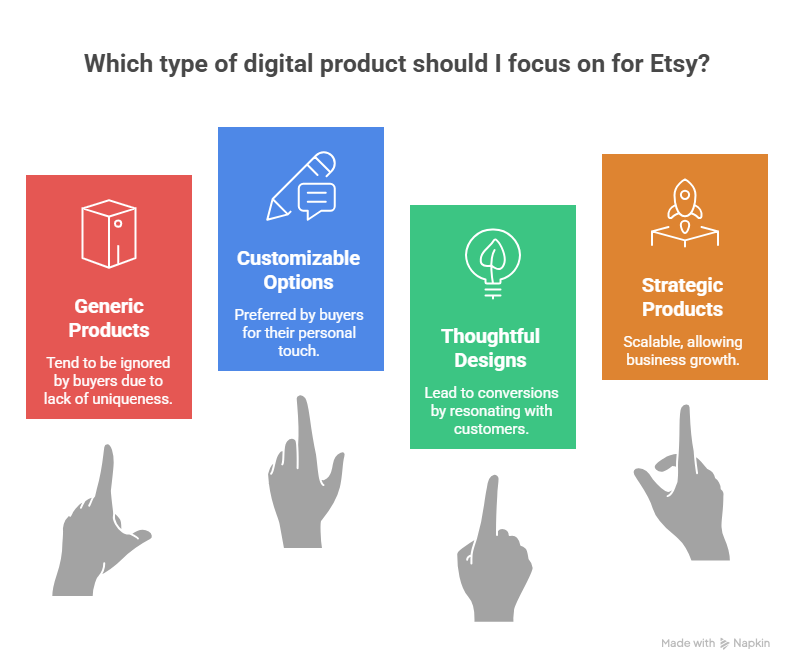
What this means for you
You’re not entering a “passive income gold rush,” but rather a highly competitive design and positioning game.
That’s not a bad thing. It just means:
- You need a niche
- You need a point of view
- You need to make something people actually want
Top selling Etsy digital products to create
Some types of digital products are saturated with low-effort listings, while others still have strong demand if you position them correctly.
Instead of listing everything, it’s more useful to focus on categories that consistently sell and understand why they work. That way, you can choose a direction and build around it, rather than guessing what might take off.
Planning & organization
This is one of the most competitive categories on Etsy, but it still performs well when you niche down properly.
What’s selling:
- Hyperlinked digital planners for apps like Goodnotes
- ADHD-friendly planners with simplified layouts
- Budget spreadsheets (Google Sheets / Excel)
- Meal planners and habit trackers
Why it works: People aren’t just buying a planner. They’re trying to solve a specific problem such as staying consistent, managing money, or building routines.
What most sellers get wrong: They create generic “daily planners” with no clear audience.
What performs better:
- “Weekly planner for ADHD adults”
- “Budget tracker for couples tackling debt”
- “Minimalist planner for busy moms”
Specificity is what gets clicks.
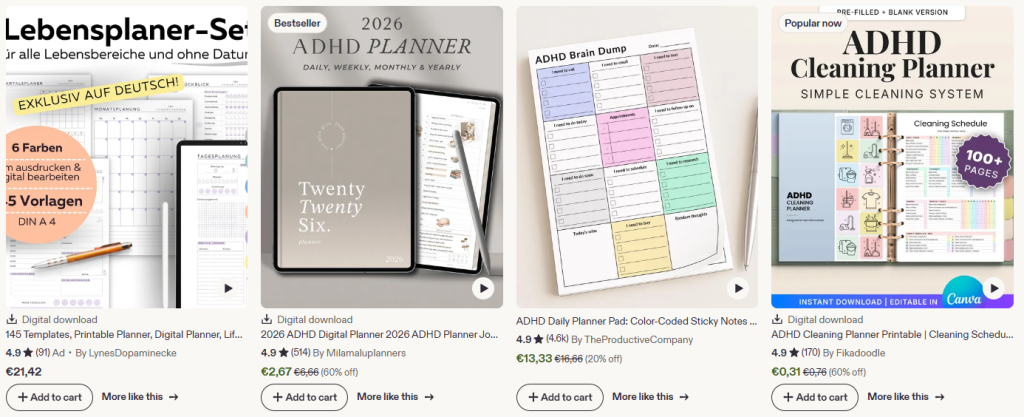
Digital ADHD planners on Etsy
Business & branding assets
This category continues to grow as more people start side hustles, freelance work, or small businesses.
What’s selling:
- Social media templates (Instagram, Pinterest, TikTok)
- Resume and CV templates
- Brand kits (logos, color palettes, font pairings)
- Media kits and pitch decks
Why it works: Buyers want to look professional without hiring a designer.
What most sellers get wrong: Templates that look good but are hard to edit or too rigid.
What performs better:
- Fully editable Canva templates
- Clean, modern layouts with clear structure
- Bundles that include multiple formats or variations
Ease of use matters just as much as design.
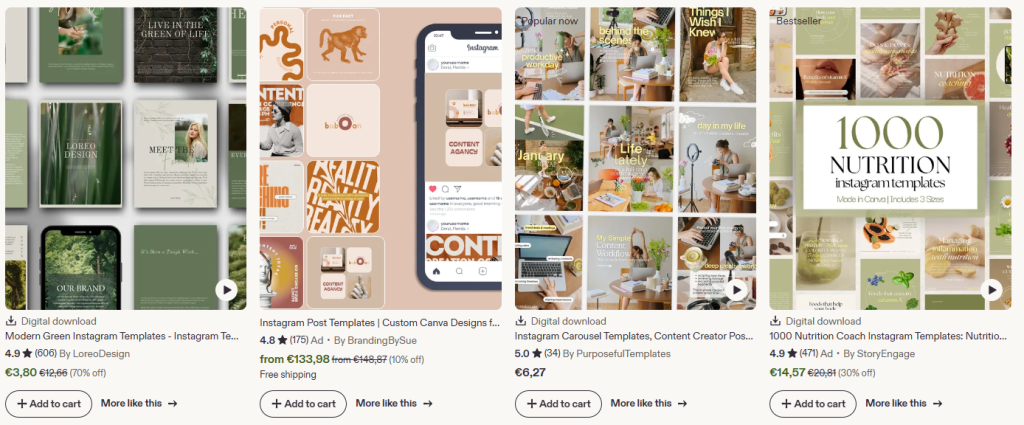
Digital Instagram templates on Etsy
Events & weddings
This is a high-intent category. People come to Etsy ready to buy, not just browse.
What’s selling:
- Editable wedding invitations
- Seating charts and signage
- Bridal shower and baby shower games
- Photo booth templates
Why it works: Events have deadlines. Buyers don’t want to design from scratch, they want something they can customize quickly.
What most sellers get wrong: Overly complex designs or files that are hard to edit.
What performs better:
- Simple, elegant templates
- Clear instructions
- Instant editing (Canva or Corjl)
Convenience wins here.
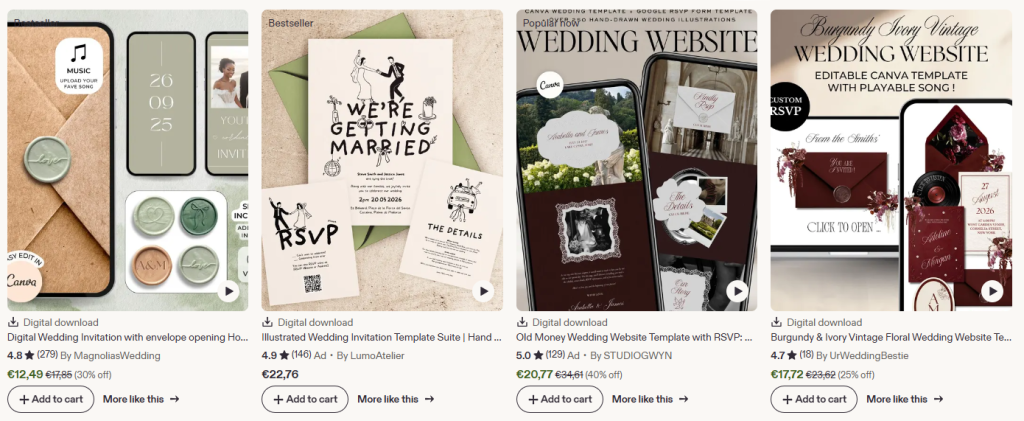
Digital wedding invitation kits on Etsy
Art & crafting files
This category has been hit hard by AI saturation, but there’s still strong demand for the right types of products.
What’s selling:
- SVG cut files for Cricut and Silhouette
- Crochet and knitting patterns
- Printable wall art (when styled well)
- Digital stickers for planners
Why it works: These products are tools, not just decoration. Buyers use them to create something.
What most sellers get wrong: Uploading generic AI-generated art with no clear style or audience.
What performs better:
- Cohesive collections (not random designs)
- Niche styles (such as cottagecore, retro, gothic)
- High-quality previews that show real use
Function + identity beats generic aesthetics.
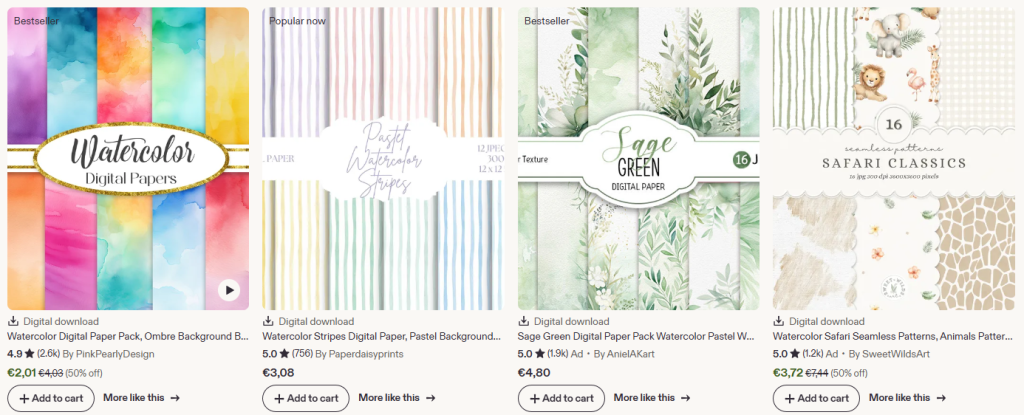
Digital paper downloads on Etsy
Creator assets & digital tools
This is one of the fastest-growing categories, especially with the rise of content creation and remote work.
What’s selling:
- Notion templates (productivity, business, life management)
- Lightroom presets
- Procreate brushes
- Stock photo bundles
Why it works: These products save time or improve output for creators.
What most sellers get wrong: Overcomplicated templates that look impressive but are hard to use.
What performs better:
- Simple, practical systems
- Clear outcomes (“content planner for solo creators”)
- Tutorials or guides included
If it feels usable immediately, it converts better.
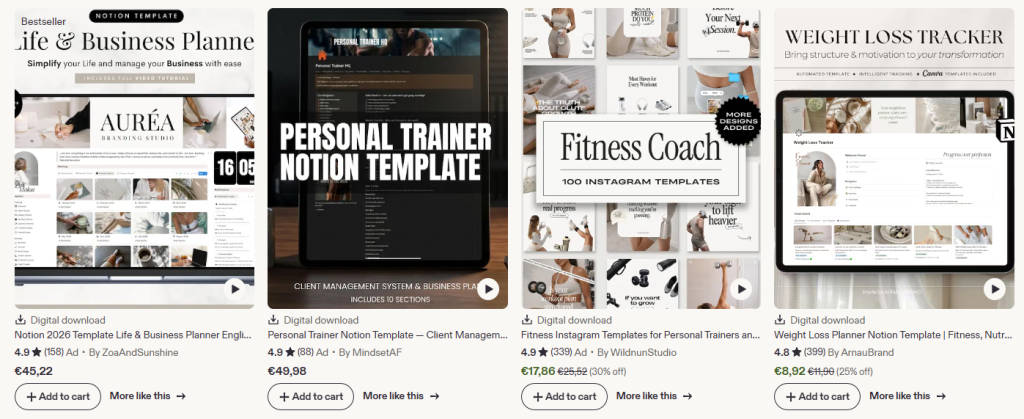
Notion templates for fitness on Etsy
A quick reality check
You don’t need to create everything. In fact, you shouldn’t.
Most successful shops:
- Focus on one category
- Go deep into one niche
- Build a consistent style and audience
Trying to sell planners, wedding templates, and Procreate brushes in the same shop usually leads to weak results across all of them.
Pick one lane, then go all in.
How to start your digital Etsy shop
The process of starting an Etsy shop isn’t complicated, but the details matter. The way you choose your niche, structure your product, and set up your listings will have a direct impact on whether your shop gets traction.
Here’s how to get the ball rolling, step by step.
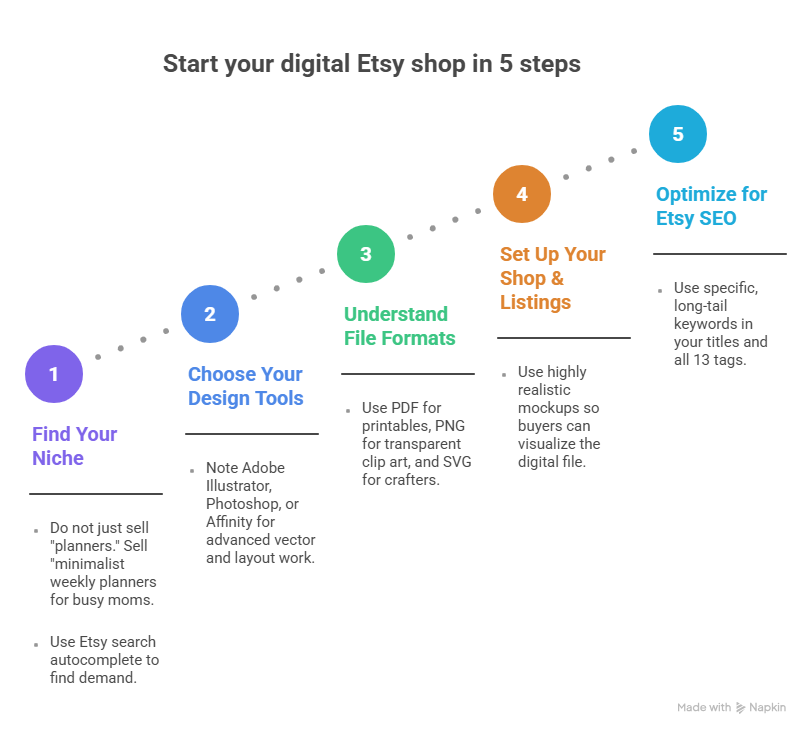
Step 1: Find a niche that already has demand
Don’t start with what you want to create. Start with what people are already searching for.
Go to Etsy and type a broad term like:
- “planner”
- “wedding invitation”
- “Canva template”
Then look at:
- Autocomplete suggestions (these are real searches)
- Listings with high review counts
- Repeating keywords across top results
You’re looking for patterns and longer searches. If you can’t clearly describe who the product is for, it’s too broad.
Step 2: Choose tools that match your skill level
You don’t need expensive software to start, but you do need tools that let you create clean, usable products.
For beginners:
- Canva is more than enough for templates, planners, and social assets
For more advanced work:
- Adobe Illustrator (vector design, SVG files)
- Photoshop (mockups, textures)
- Affinity Designer as a lower-cost alternative
What matters most is usability. Your files should be easy to edit, your layouts clean, and your product should work exactly as expected. Complicated tools don’t automatically mean better products.
Step 3: Use the right file formats (this matters more than people think)
Your format should match how the buyer will use the product.
Common formats:
- PDF: Printables, planners, guides
- PNG: Transparent graphics, clip art
- SVG: Cutting machines like Cricut
- Canva links: Editable templates
People usually run into problems when their files require extra steps or don’t come with clear instructions. If your buyer has to figure things out, you’ll get messages, refunds, or bad reviews. Keep it simple.
Step 4: Set up listings that actually convert
Your product isn’t just the file, it’s also how you present it.
Etsy allows up to five files per listing (20MB each) and multiple images, and you should use that space properly. Your listing needs to show the product clearly, not just exist.
Focus on clear, realistic mockups that show the product in use, along with close-ups and a simple breakdown of what’s included. A single flat image of the file isn’t enough. Buyers want to see how it looks, how it’s used, and what they’re actually getting.
The easier it is to understand at a glance, the more likely it is to convert.
Step 5: Optimize for Etsy search (SEO)
Etsy is a search-driven platform. If you’re not using the right keywords, your product won’t show up.
Each listing gives you a title, 13 tags, and a description, and all of them should work together. Focus on long-tail keywords that reflect how buyers actually search, and make sure your title and tags align instead of competing with each other.
Avoid vague titles like “beautiful planner” or stuffing in too many keywords. A strong title is clear and specific, for example: “Editable Budget Planner Spreadsheet for Couples (Google Sheets Template).”
You’re writing to match search intent, not to attract a blanket audience.
Another reality check
Your first product probably won’t take off, and that’s both normal and not something to stress over!
Most successful shops:
- Test multiple listings
- Learn what gets clicks and saves
- Improve based on real data
This is less about getting it perfect upfront and more about building momentum.
Tip: Looking for more? Our guide to selling digital products can give you the knowledge you need to start selling confidently.
The reality of selling digital downloads (mindset for success)
Digital products are often marketed as “set it and forget it” income.
In reality, most Etsy shops never get traction, and a large percentage of listings receive little to no visibility or sales. That’s because the bar is higher than people expect.
If you treat this like a quick side hustle, it usually stays one.
You do the work upfront (not after the sale)
Getting traffic is the real challenge.
Etsy sees around 450 million monthly visits, but that attention is spread across millions of listings. Most products don’t get consistent visibility right away, and many never reach that point.
That’s why early results are often slow. You’re not just uploading a product, you’re competing for placement in search.
The shops that grow tend to build momentum over time. They add more listings, refine their keywords, and improve how their products are presented. Each listing becomes another chance to be discovered.
That’s the work most people underestimate.
Don’t be afraid to invest
Low-effort products tend to get lost.
If you want to stand out, you’ll likely need to invest in better design assets, tools, or skills. The difference between a basic product and a polished one is often what drives conversions.
This matters even more when you look at earnings. Some estimates suggest median Etsy seller revenue is around $574 per month, which shows how many shops operate at a relatively small scale .
That makes positioning, quality, and perceived value much more important than simply pricing low.
Listen to your customers
Customer feedback is one of your best data sources.
Reviews and messages will quickly show you what’s missing or unclear. If buyers keep asking for a different format or feature, that’s direction.
Many successful shops grow by expanding on what’s already working instead of constantly starting from scratch.
What this means for you
If you’re willing to treat this like a real project, not a quick experiment, you can still build something that generates steady income.
Just expect:
- A slow start
- Some trial and error
- A learning curve at the beginning
That’s typical, and it’s also where most people drop off.
Common mistakes to avoid
Most Etsy shops don’t fail because the idea is bad. They fail because of a few predictable mistakes that quietly kill visibility, conversion, or profit.
Ignoring copyright and licensing
This is one of the fastest ways to lose your shop.
Using:
- Free fonts without a commercial license
- Copyrighted characters or brand elements
- Reselling assets you don’t own
…can lead to listing removals or full account suspension.
Etsy has been increasing enforcement as the platform grows, especially with the rise of AI-generated and mass-produced content. The more saturated the marketplace becomes, the stricter these rules get.
This isn’t optional. If you’re selling, you’re running a business.
Treating your listing like an afterthought
You can have a great product and still get zero sales.
Why? Because Etsy is a search + conversion platform. If your listing doesn’t:
- Show clearly what the product is
- Look polished
- Match what buyers expect
…it won’t convert, and conversion matters.
A typical e-commerce conversion rate sits around ~2-3%, meaning the vast majority of visitors don’t buy.
That means small improvements in your images, clarity in your listings, or niche positioning can make a massive difference.
Pricing too low (and killing your own margins)
This is one of the most common beginner mistakes.
The logic is usually “if I make it cheaper, more people will buy”.
The reality:
- Etsy takes a cut (listing fee, ~6.5% transaction fee, payment processing, etc.)
- Low pricing reduces perceived value
- You need a lot more sales to make meaningful income
To put it into perspective, many sellers only make a few dollars per sale after fees. Undercutting your pricing just makes it harder to climb out of that hole.
Trying to sell everything at once
A lot of new shops try to cover too much at once, mixing planners, wedding templates, wall art, and Notion templates in a single storefront. The result is usually the same, meaning no clear audience, weak branding, and poor search relevance.
Etsy’s algorithm favors relevance. If your shop doesn’t clearly signal what it’s about, it becomes harder to rank and easier to overlook.
The shops that perform well tend to take a more focused approach. They pick one niche, build depth within it, and expand in a way that still makes sense for their audience, rather than jumping between unrelated categories.
Skipping instructions (and creating support problems)
Digital products may seem automatic, but buyers still need guidance. Without clear instructions, you’ll run into avoidable issues like confused messages, bad reviews, and refund requests, especially with things like Canva templates, zipped files, or multi-file downloads.
A simple PDF that explains the basics can make a big difference. It should cover:
- How to access the files
- How to edit them
- What tools are required
This small step can save you hours of support time and help protect your ratings.
Expecting fast results (and quitting too early)
This is the quiet killer.
The numbers tell the story:
- Newer sellers make less than $200 per month
- Only a smaller percentage reach consistent monthly income
That doesn’t mean it doesn’t work. It means most people upload a few products, don’t see immediate results, and stop before momentum has a chance to build.
The shops that grow take a different approach. They keep listing, keep improving, and refine their products based on real data over time.
None of these mistakes are complicated, but they compound quickly. Avoiding these alone already puts you ahead of a huge percentage of sellers.
Conclusion
Selling digital products on Etsy is still a viable path in 2026, but it’s no longer something that works by default. The low barrier to entry has made the marketplace more competitive, which means results now depend much more on how well you execute.
Most listings fail because they’re too generic or don’t clearly solve a specific problem. The shops that grow tend to take a different approach. They focus on a defined niche, create products with a clear use case, and make sure everything from the design to the listing is easy to understand and use.
Over time, they improve by paying attention to what buyers respond to and adjusting accordingly.
This isn’t a quick win or a passive income shortcut. It’s a process that takes testing, iteration, and a bit of patience at the beginning. But for sellers who are willing to treat it seriously, the opportunity is still there.
Start with one product, make it as strong as you can, and use what you learn to improve the next one. That’s how you build momentum.
FAQs
How does Etsy deliver digital files to the buyer?
When a customer purchases a digital product, Etsy automatically provides a download link after checkout. Buyers can access their files through their account under “Purchases and Reviews,” or via a download link sent to their email.
What happens if my file is larger than the 20MB limit?
Etsy allows up to 5 files per listing, each with a maximum size of 20MB.
If your files are larger, compress them into a ZIP folder or upload them to a cloud service (like Google Drive) and include a PDF with the download link. Make sure your instructions are clear so buyers know exactly how to access everything.
Do I have to accept returns on digital downloads?
No. Because digital products can’t be “returned” once downloaded, most sellers do not offer refunds. However, you’re still responsible for delivering what was promised and helping customers if they have issues accessing or using the file. Clear descriptions and instructions cut down on refund requests.
Can I sell AI-generated art on Etsy?
Yes, but with limitations.
Etsy allows AI-assisted products, but your listings must:
- Follow copyright and licensing rules
- Clearly represent what the buyer is getting
- Avoid misleading or mass-produced content
More importantly, buyer behavior is shifting. Products that look overly generic or fully AI-generated tend to perform worse compared to designs with a clear style or human touch.

